
Introduction: Tackling Chronic Purity Losses in Sugar Processing
Daily Crushing: 12000 TCD sugarcane
Mixed Juice Generation: 12000 KL (Brix-14.52, Pol-11.76, Purity-80.99)
Syrup Diversion to Distillery: 30% (3600 KL)
Ethanol and RS: 14 %v/v and 0.29 %w/v
Retention Time: 50 Hrs (Feeding-25 Hrs, retention-25 Hrs)
Distillery Production: 240 KLPD
In the competitive Indian sugar industry, mills face relentless pressure from fluctuating cane quality, microbial contamination, and process inefficiencies. A leading integrated sugar-distillery operation struggled with persistent purity drops averaging 1.1-1.22%, translating to 14 MT daily sugar losses worth INR 4.2 lakh (MSP INR 31/kg) alone. Other by products Volatile acids (VA up to 7,940 ppm), lactic acid (1,405 ppm), and residual sugars (0.52% w/v) exacerbated fermentation losses, while distillery yields lagged lower ethanol yield, more retention time with poor spent wash recycling.
This case study documents a 51-day trial (Dec 2025-Jan 2026) where The Catalysts Group deployed Bactosafe I and II—proprietary enzyme formulations for microbial control. Dosed alternately at just 6 ppm on cane crush quantity (usages help in restricting microbial resistance and uncontrolled proliferation), these enzymes eliminated microbial degradation root causes. Combined with disciplined monitoring (pH/Brix/POL/purity in PJ/MJ, VA/lactic in MJ/syrup/SW) and CIP sanitization, the intervention slashed purity drops by 90%, delivered INR 4.78 lakh daily net profit, and unlocked scalable gains up to INR 2.01 lakh/day.
Mill Condition Before Intervention: A Process Under Siege
The mill's baseline revealed systemic vulnerabilities across crushing rates of 12000 TCD:
Parameter | Historical Control | Recent Control | Impact |
Purity Drop | 1.22% | 1.12% | 0.1% reduction. 15 MT sugar loss prevented 1.4 Cr/Monthly Saving |
Volatile Acid | 7,940 ppm | 1,779 ppm | 6,161 ppm |
Lactic Acid | 1,405 ppm | 628 ppm | 777 ppm |
Fermentation RS | 0.52 % w/v | 0.29 % w/v | 0.23% indication stress reduction, Yeast boost |
SW Recycling | 8.83 % | 12.14 % | 3.31% indicating overall process improvement |
Distillery Ethanol | 212 KLPD | Suboptimal yield |
Root Causes: Uncontrolled bacterial load reduced POL retention, accelerated purity collapse in process juices, and contaminated syrup for distillery transfer. Spent wash recycling stagnated at 8.83%, with high process water consumption compounding costs.
Catalysts Group's Targeted Recommendations
The Catalysts Group prescribed a precision protocol leveraging their biotech expertise:
- Enzyme Dosing: Alternate Bactosafe I and II at 6 ppm (total 72 kg/day recommended dose for Catalyst’s product alternatively every 15th days).
- Real-Time Monitoring:
- PJ/MJ: pH, Brix, POL, purity drop (Thrice per shift)
- Syrup/Spent Wash: VA and lactic acid (Once per Shift)
- Process Hygiene: CIP sanitization for mills as "key booster"
- Distillery Optimization: Blend 40% MJ in syrup, 40 brix uniform syrup output; maximize SW recycling
This low-dose, high-discipline approach targeted microbial hotspots without overhauling infrastructure.
Post-Intervention: Dramatic Process Transformation
Within weeks, metrics confirmed enzyme efficacy:
Post-Intervention: Dramatic Process Transformation
Within weeks, metrics confirmed enzyme efficacy:
Sugar Mill Recovery
- Purity drop: 0.11% w/w avg (10% reduction)
- Daily savings: 15.16 MT sugar - INR 4.70 lakh/day (INR 1.41 Cr/month)
- Impurity Reductions:
Total sugar equivalent saved: 1.03% w/v across parameters.
Distillery Performance (Additional Benefits)
- Control: 212 KLPD: Trial: 239 KLPD (+26.7 KL/day; 12.6% uplift)
- Efficiency: +2.29% ethanol recovery (40° Brix syrup); +0.32% v/v titer
- Resource Savings: 16% process water ; 11% SW recycling (52 m³ reused vs 40 m³)
- Batch Metrics: RS 0.40% cycle time -1 hr/batch; net SW ~60%
Quantified Benefits: Direct ROI + Compounding Gains
Benefit Category | Daily Gain | Monthly (30 days) |
Sugar Recovery | INR 4.70 lakh | INR 1.41 Cr |
Net ROI (after cost) | INR 4.78 lakh | INR 1.43 Cr |
Distillery Ethanol (30% diversion) | INR 1.06 lakh | INR 31.7 lakh |
Syrup Process (70%) | INR 95,591 | INR 28.7 lakh |
Total @ 12k TCD | INR 2.01 lakh | INR 6.04 C |
Compounding Effects: 2.3% distillation energy savings, ETP volume reduction, consistent gravity drops to 1.000, and high-purity MJ for seamless syrup handling.
Breakthrough Success: A Template for Industry Transformation
This trial represents Catalysts Group's technical mastery in enzyme-driven microbial control, achieving:
- 10% purity drop elimination at minimal 6 ppm dosing
- 12.6% ethanol yield surge as proven ancillary benefit
- ROI in weeks: INR 8,640/day investment - INR 4.78 lakh/day return (product cost can be calculated here, better not to show)
- Scalable blueprint: Works across variable crushing (5k-20k TCD)
The operation's discipline—real-time analytics + CIP—amplified enzyme impact, setting a gold standard for integrated sugar-distillery optimization. This success validates Catalysts' value proposition amid India's ethanol blending mandates and cane price volatility.
Conclusion & Results: Ready-to-Replicate Efficiency
The intervention converted a loss-making process into a high-margin operation, proving that targeted enzymes address root-cause microbial threats more effectively than traditional chemicals. Total projected savings: INR 6 Cr/month at scale.
Key Takeaway: With Bactosafe I/II at 6 ppm + monitoring + CIP, any sugar mill can capture 1%+ sugar recovery while boosting distillery yields—delivering INR 2 Cr+ monthly competitive advantage.
Final Results Snapshot:
1. 10% Purity Drop Reduction
2. INR INR 4.78L Daily Net Profit
3. 239 KLPD Ethanol (+12.6%)
4. 16% Water Savings
5. Scalable to INR 6 Cr/Month
This case study demonstrates The Catalysts Group's ability to deliver measurable, bankable results through biotechnology precision.
Recent Posts
SafSpirit™ M-1: Building Premium Malt Spirits from the Fermentation Stage
Discover SafSpirit™ M-1, where premium malt spirits are crafted from the fermentation stage. Elevate your spirits experience with our expert techniques.
-1775618224.png)
HPLC Analysis of Fermented Wash in Grain Ethanol Production: What Your Sample Is Really Telling You
Discover the insights HPLC analysis provides in fermented wash for grain ethanol production. Uncover what your sample reveals about quality and efficiency.
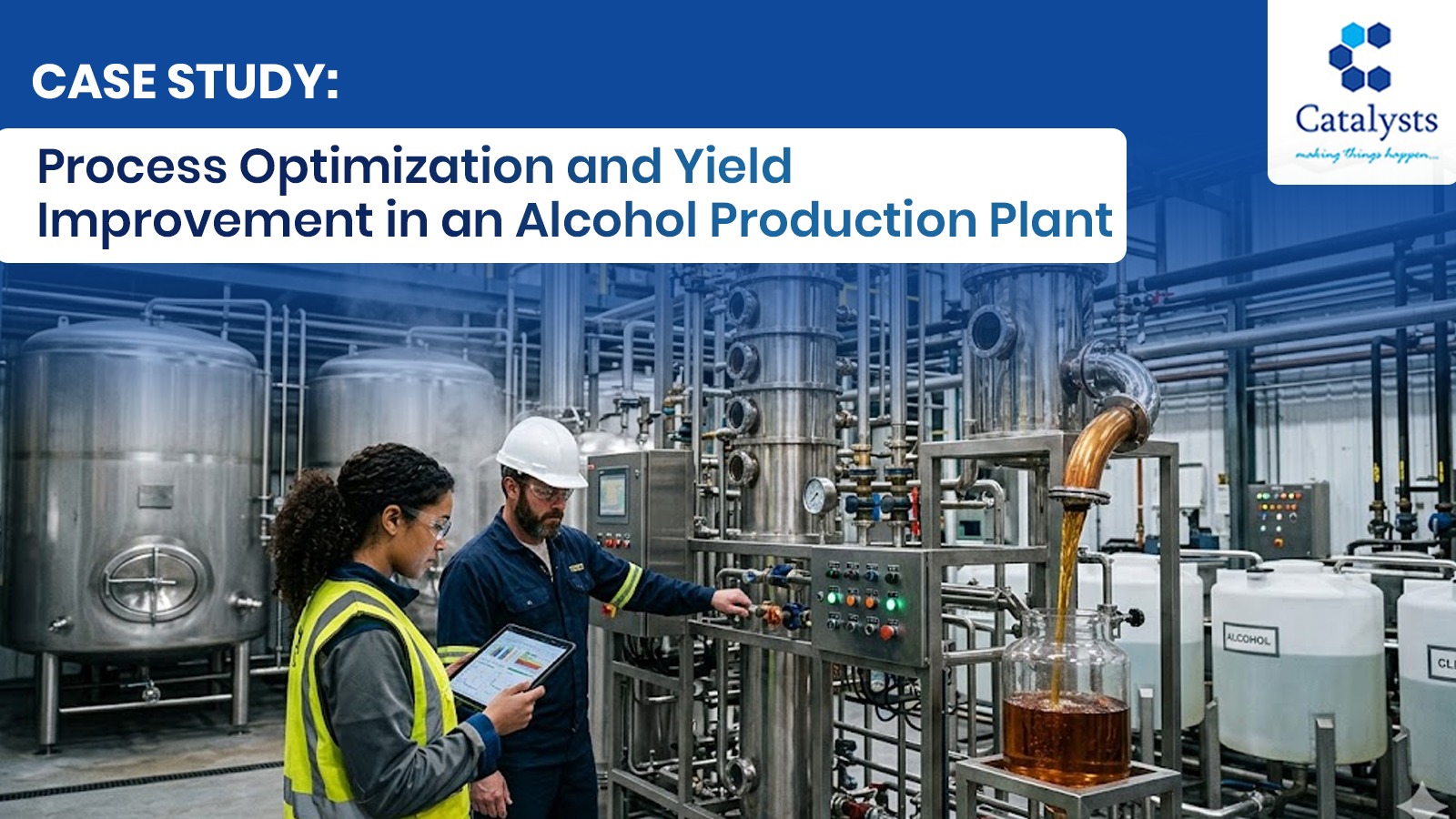
Case Study: Process Optimization and Yield Improvement in an Alcohol Production Plant
Uncover the strategies behind successful process optimization and yield enhancement in an alcohol production plant, leading to significant performance gains.
Catalysts Connect
Keep up to date with our latest news and analysis by subscribing to our regular magazine and newsletter
Post a comment
Your email address will not be published.