
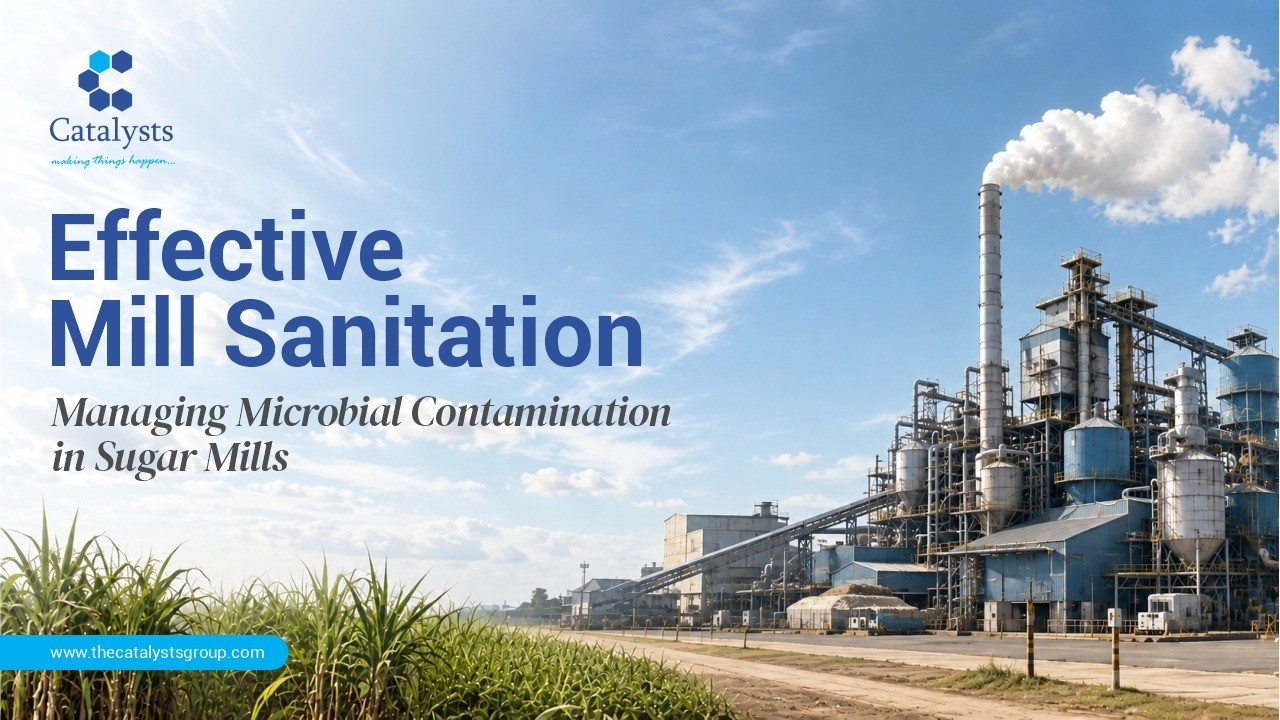
Sugar processing provides favourable conditions for microbial growth, particularly because of the availability of sugars and nutrient-rich process streams. When unwanted microorganisms grow unchecked, they can contribute to sucrose losses, purity reduction and process inefficiencies.
This makes one question important for sugar mills:
How effectively are you managing microbial contamination before it impacts process performance?
Why Mill Sanitation Matters
Microbial contamination can vary with cane quality, crushing conditions and the time between harvesting and processing. Once established, microbial activity can affect the quality of process streams and contribute to sugar losses.
For mill operators, the impact may appear as:
- Sucrose losses
- Purity drops
- Process instability
- Increased contamination-related challenges
- Reduced overall process efficiency
Effective sanitation therefore needs to focus on controlling microbial growth while maintaining smooth and consistent mill operation.
A Process-Specific Approach to Microbial Control
Not every mill experiences the same microbial challenge. Crushing rate, cut-to-crush delay, contaminant load, retention time and contamination generation points can all influence sanitation requirements. This means effective sanitation is not simply about increasing sanitizer dosage. The right product, dosage and dosing point need to match the actual process conditions. This is where a targeted microbial-control programme can make a difference.
Three Solutions for Effective Mill Sanitation-
Bactosafe-I
- Bactosafe-I is a new-generation mill sanitizer designed to control undesirable microbial contaminants during sugar processing.
- It is designed to work across different cane varieties and process conditions, while helping reduce microbial growth, purity drops and sugar losses.
- Its dosage and dosing points can be fine-tuned at plant level according to actual operating conditions for optimized performance.
Bactosafe II
- Bactosafe II is an advanced mill sanitizer developed to control unwanted microbial growth across sugar-processing systems.
- It helps reduce sucrose losses and purity drops while supporting stable process performance under varying cane quality and operating conditions.
- Its application can be optimized based on factors such as crushing rate, cut-to-crush delay and contaminant load, allowing the sanitation programme to be adapted to the mill's requirements.
Bactoshield
- Bactoshield is a membrane-active antimicrobial blend designed for broad-spectrum microbial control, improved process hygiene, and effective management of lactic acid levels in sugar processing.
- It is designed for microbial control in sugar-processing systems and can also be used during sanitation/CIP and recycling-stream applications in molasses and grain industries.
- Bactoshield also helps reduce scum formation, providing additional support where microbial activity contributes to process-hygiene challenges.
The Goal: Cleaner and More Stable Processing
Effective microbial control is ultimately about protecting the process. A well-managed sanitation programme can help mills:
- Reduce microbial-related sugar losses
- Maintain process quality
- Support more stable operations
- Minimize contamination-related challenges
- Improve overall process efficiency
The key is to identify where microbial pressure is developing and select an appropriate solution and application strategy.
Conclusion
A cleaner mill starts with keeping microbial activity under control. When sanitation is aligned with the mill’s operating conditions, it can help limit contamination-related losses and support smoother processing. With Bactosafe-I, Bactosafe II and Bactoshield, The Catalysts Group offers solutions designed to address different microbial-control requirements across sugar-processing operations.
Good sanitation is not just about cleanliness—it is about protecting what the mill is working to recover.
Want to explore what an effective microbial-control programme could look like for your mill? Let’s talk.
Recent Posts
-1789047746.jpeg)
HPLC Monitoring in Ethanol Fermentation: From Hidden Losses to Better Process Decisions
Learn how HPLC monitoring transforms ethanol fermentation by uncovering hidden losses and facilitating strategic process decisions for enhanced productivity.
How Bactoshield Strengthened Fermentation Performance in a Syrup-Based Ethanol Distillery
Explore the impact of Bactoshield on fermentation in syrup-based ethanol distilleries, driving efficiency and maximizing output for distillers.
-1785425257.jpg)
Grain vs Molasses: Which Feedstock Creates the Bigger Process Challenge?
Explore the challenges of using grain versus molasses as feedstocks. Uncover insights on efficiency, cost, and processing difficulties in this comprehensive analysis.
Catalysts Connect
Keep up to date with our latest news and analysis by subscribing to our regular magazine and newsletter
Post a comment
Your email address will not be published.