
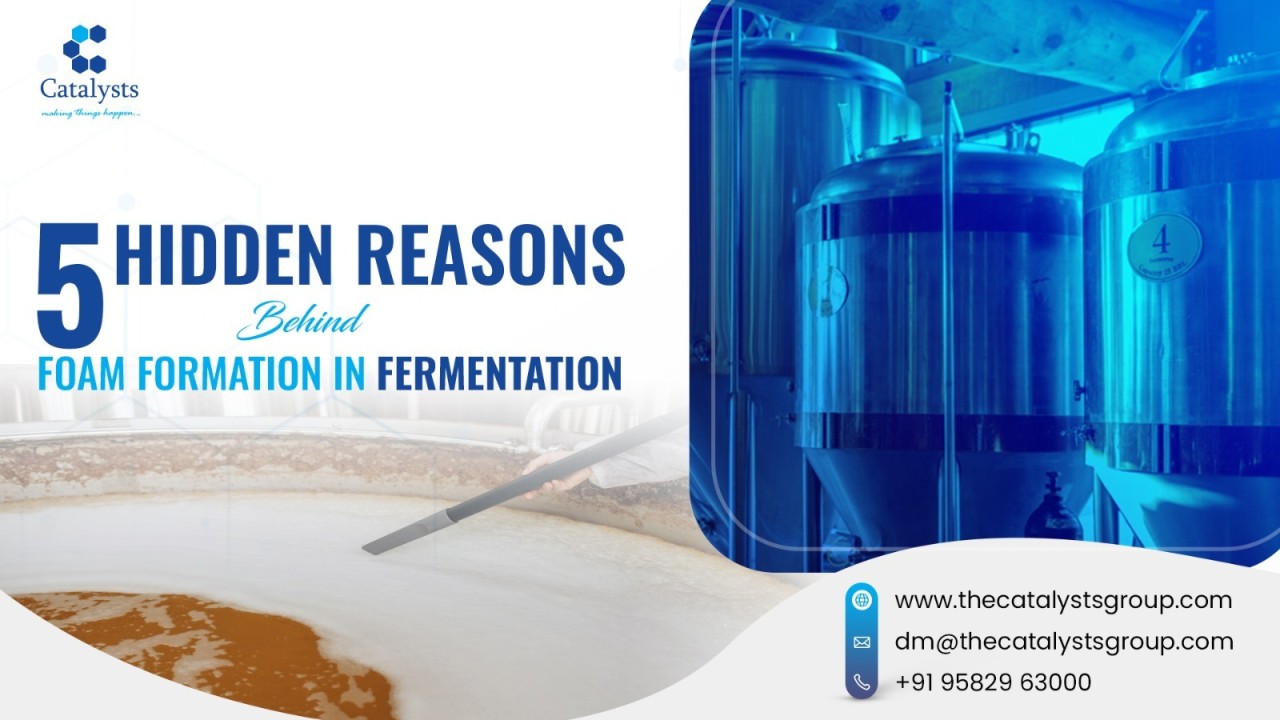
Foam formation during fermentation is often seen as a minor operational issue. But in reality, foam is a visible signal of what is happening inside the fermenter.
In molasses and grain fermentation, excessive foam can reduce working volume, cause overflow, increase contamination risk, disturb process control, and raise antifoam consumption. More importantly, it may indicate deeper process challenges such as contamination, high viscosity, unstable yeast activity, or raw material variation.
Foam forms when gas bubbles, mainly carbon dioxide, get trapped and stabilized by surface-active compounds present in the fermentation medium. Here are five hidden reasons behind foam formation in fermentation.
1. Rapid CO2 Release During Fermentation
During alcoholic fermentation, yeast converts fermentable sugars into ethanol and carbon dioxide. When yeast activity is high, CO2 is released rapidly.
These gas bubbles rise through the broth and reach the surface. If the medium contains proteins, gums, solids, or other foam-stabilizing compounds, the bubbles do not break easily. Instead, they accumulate as foam.
This is why foam is usually more visible during the peak fermentation stage, when sugar conversion and CO2 evolution are at their highest.
Process signal: Excessive foam may indicate rapid fermentation, poor gas release, or unstable broth conditions.
2. Proteins and Natural Surfactants in Feedstock
Fermentation feedstocks such as molasses, grain mash, and cane-based substrates are naturally complex. They contain proteins, peptides, gums, fibers, polysaccharides, minerals, and suspended solids.
Many of these compounds behave like natural surfactants. They reduce surface tension and form a thin film around gas bubbles. This film prevents bubbles from collapsing quickly, making foam thicker and more stable.
In simple terms: The more surface-active impurities present in the medium, the stronger and more persistent the foam becomes.
3. Microbial Contamination
Foam can also be a warning sign of microbial contamination.
In distillery fermentation, bacteria such as lactic acid bacteria compete with yeast for sugars and nutrients. They may produce organic acids, extracellular polymers, and other metabolites that disturb the fermentation environment.
This can increase viscosity, stress yeast, change surface activity, and contribute to unstable foam formation.
Warning signs include:
· Sudden increase in foam
· Drop in pH
· Higher lactic acid or volatile acidity
· Slower fermentation
· Higher residual sugars
· Lower alcohol yield
This is why foam should not always be treated only with antifoam. Sometimes, the real problem is microbial imbalance.
4. High Viscosity and Suspended Solids
A thick fermentation broth traps gas bubbles more easily.
In grain fermentation, poor liquefaction, high solids loading, residual starch, and incomplete hydrolysis can increase viscosity. In molasses fermentation, gums, colloids, and suspended impurities may create a similar effect.
When broth viscosity is high, bubbles rise slowly and remain trapped for longer. This leads to persistent foam formation.
Technical point: Foam becomes more stable when liquid drainage between bubbles slows down. High viscosity reduces drainage and helps foam stay longer.
5. Incorrect or Excessive Antifoam Use
Antifoam is useful, but it is not always the complete solution.
A good antifoam helps break foam films and release trapped gas. However, incorrect selection or excessive dosing can affect process performance, product recovery, and overall chemical load.
In some cases, antifoam only hides the visible foam while the actual issue continues inside the fermenter.
For example, if foam is caused by contamination, high viscosity, or poor raw material quality, adding more antifoam will not solve the root cause.
Best approach: Use antifoam as a control tool, but combine it with process monitoring and correction.
What Foam Is Really Telling You
Foam is not just a surface problem. It is a process signal.
Foam Observation | Possible Reason |
Foam rises suddenly | Contamination or rapid CO2 release |
Foam is thick and stable | High proteins, gums, or solids |
Foam appears batch-to-batch | Raw material variation |
Foam does not reduce easily | High viscosity or wrong antifoam |
Foam comes with low yield | Yeast stress or bacterial activity |
Conclusion
Foam formation in fermentation reflects the interaction between gas release, feedstock quality, microbial activity, viscosity, yeast performance, and chemical control.
A small amount of foam may be normal. But excessive or persistent foam should be investigated carefully.
When foam is understood correctly, it helps plant teams identify process issues early, improve fermentation stability, reduce losses, and support better alcohol yield.
Foam is not just what appears on the surface. It is what the fermentation process is trying to tell you.
Recent Posts
How Bactoshield Strengthened Fermentation Performance in a Syrup-Based Ethanol Distillery
Explore the impact of Bactoshield on fermentation in syrup-based ethanol distilleries, driving efficiency and maximizing output for distillers.
-1785425257.jpg)
Grain vs Molasses: Which Feedstock Creates the Bigger Process Challenge?
Explore the challenges of using grain versus molasses as feedstocks. Uncover insights on efficiency, cost, and processing difficulties in this comprehensive analysis.
DDGS Quality: What Distilleries Often Overlook
Uncover the critical factors of DDGS quality that distilleries frequently miss. Enhance your distilling process and optimize feed efficiency today.
Catalysts Connect
Keep up to date with our latest news and analysis by subscribing to our regular magazine and newsletter
Post a comment
Your email address will not be published.